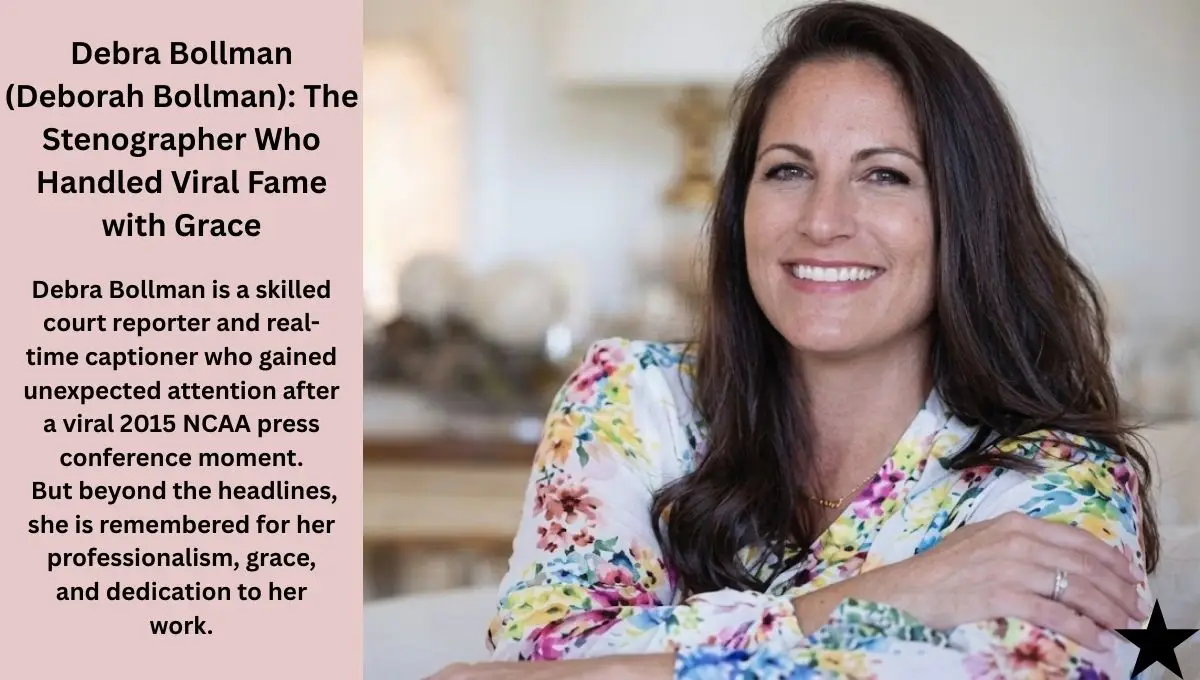
Debra Bollman is a respected court reporter, stenographer, and real-time captioner whose life briefly changed after a surprising viral moment in 2015. During an NCAA press conference, Nigel Hayes of the Wisconsin Badgers made an offhand comment that unexpectedly drew massive public attention to Bollman, turning a quiet professional into an internet headline overnight.
Yet Debra Bollman’s story is about far more than sudden fame. Known for her professionalism and decades of skill behind the keyboard, she returned to her work with grace and focus, showing that true success is built on dedication rather than attention. Her journey remains a memorable example of how talent, dignity, and composure can stand out even in the middle of a viral storm.
Debra Bollman Biography and Quick Facts
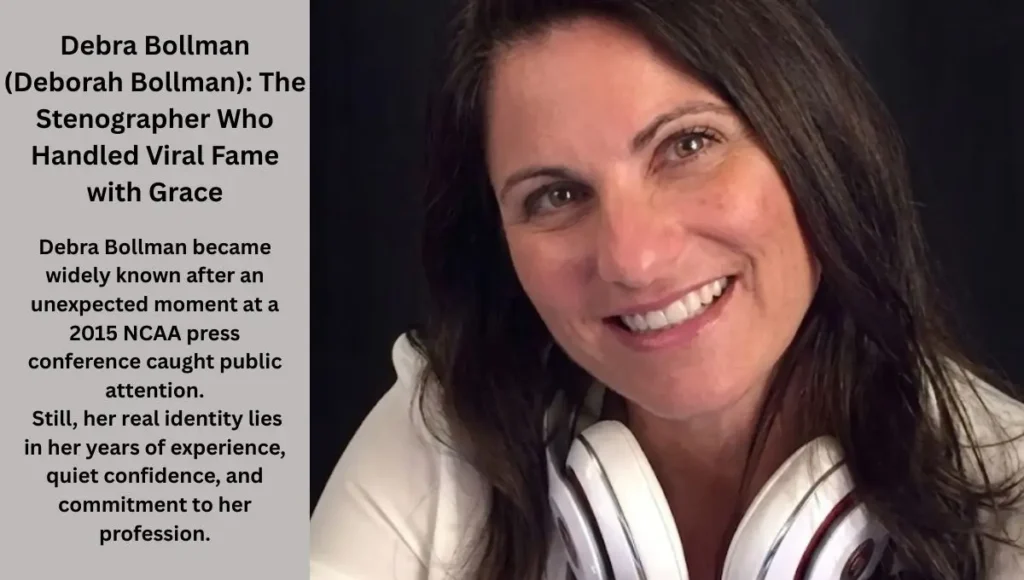
Here is a quick overview of Debra Bollman’s personal and professional life:
| Detail | Information |
| Full Name | Debra Bollman |
| Date of Birth | 1972 |
| Age | 54 years old (2026) |
| Height | 5 feet 6 inches (167 cm) |
| Weight | 61 kg (134 lbs) |
| Eye Color | Dark Brown |
| Hair Color | Blonde |
| Birthplace | Riverside, California, USA |
| Nationality | American |
| Education | California School of Court Reporting |
| Profession | Stenographer, Court Reporter, Real Estate Agent |
| Typing Speed | 300+ words per minute |
| NCRA Member Since | 1997 |
| Viral Moment | 2015 NCAA Basketball Press Conference |
| Husband | Anthony J. Farfan |
| Marriage Date | September 5, 2017 |
| Children | Sophia, Saylor, and Simeon |
| Location | Norco, California |
| Estimated Net Worth | $1 Million – $2 Million (approx.) |
| Professional Role (2016–17) | Vice President, California Court Reporters Association |
Early Life and Education
Debra Bollman was born in 1972 in Riverside, California, a city in the Inland Empire region of Southern California. She grew up in a community that valued hard work and practical skills, qualities that would later define her professional identity.
From an early age, Debra showed a strong aptitude for language, precision, and focused attention, traits not typical of many young people but essential in the world of stenography. Her early education laid the groundwork for a career that demands both mental agility and physical coordination.
After completing her foundational schooling, she enrolled at the California School of Court Reporting, one of the state’s respected institutions for training professional stenographers. Stenography is far more demanding than conventional typing. Students must master a shorthand keyboard system that allows simultaneous key presses to create phonetic syllable combinations, producing complete words and phrases in a fraction of the time it takes to type them letter by letter.
Through rigorous training and genuine passion for her craft, Debra developed a typing speed exceeding 300 words per minute, a benchmark that places her among the top-tier professionals in the court reporting industry.
Professional Career in Stenography
Debra Bollman launched her professional stenography career in the late 1990s. In 1997, she became a certified member of the National Court Reporters Association (NCRA), the leading professional body that sets standards and supports court reporters across the United States.
Over the following two decades, she built a broad and impressive portfolio of work across multiple settings. Her expertise covers several specialized areas of court and media reporting:
| Service Type | Description |
| Courtroom Reporting | Verbatim transcription of live legal proceedings |
| Trial Transcription | Producing official transcripts for court records |
| Real-Time Captioning | Live text displayed on screen for broadcasts and accessibility |
| Press Conference Transcription | Capturing spoken word at high-profile media events |
| Sports Event Reporting | Live captioning at major athletic press conferences |
Debra worked extensively with ASAP Sports, a company specializing in sports press conference transcription services used by media outlets worldwide. Her role there required not only speed but the ability to accurately capture names, sports terminology, and fast-paced dialogue in a live environment.
Real-time captioning, one of her specialties, requires that the stenographer’s text appear on screen with virtually zero delay. This service is critical for television broadcasts and for providing accessibility to hearing-impaired audiences. It is among the most technically demanding roles a court reporter can perform.
Leadership Role: Between 2016 and 2017, Debra served as Vice President of the California Court Reporters Association (Cal-CCRA). In this capacity, she contributed to training programs, professional advocacy, and initiatives aimed at sustaining the stenography profession amid growing technological change.
The 2015 NCAA Viral Moment
In March 2015, Debra Bollman was doing what she had done hundreds of times before, sitting quietly at a press conference, fingers flying across her stenography machine, capturing every word spoken. The event was an NCAA basketball tournament press conference at the Staples Center in Los Angeles featuring the Wisconsin Badgers.
What happened next was unscripted and entirely unexpected. Wisconsin Badgers forward Nigel Hayes leaned toward a microphone that he did not realize was still live and whispered, “God, she’s beautiful,” apparently referring to Debra, who was seated nearby at her workstation.
The comment was broadcast live to the audience in the room. Within hours, video clips circulated across Twitter, Facebook, and sports media platforms, earning millions of views globally. The story was picked up by major outlets including ESPN, Sports Illustrated, and ABC News.
What the world noticed most, however, was not the comment itself, but Debra’s reaction. She looked up briefly, offered a composed smile, and returned immediately to her work. No embarrassment. No distraction. Pure professionalism.
Key Detail: The viral moment was not staged or rehearsed. It happened during a live NCAA tournament game press conference and was captured on broadcast cameras operating in real time.
Response to Sudden Public Attention
After the clip spread globally, media invitations and public attention came quickly. News programs, sports channels, and entertainment outlets reached out for interviews and appearances. For many people, this level of sudden exposure would be irresistible.
Debra Bollman chose a different path. She declined to leverage the moment for personal celebrity. Instead, she returned to her work, her family, and the professional routines that had defined her life long before anyone outside the court reporting world knew her name.
This decision was widely noted. Fellow court reporters, journalists, and general viewers praised her for embodying exactly what professionalism looks like under pressure. She did not become a cautionary tale about internet fame; she became an example of grace, humility, and groundedness.
Her response also gave the moment deeper meaning. Rather than a story about a player’s comment, it became a story about the dignity of skilled behind-the-scenes professionals, and how composure, not spectacle, can make the most lasting impression.
Expansion into Real Estate
Alongside her stenography career, Debra Bollman obtained a California real estate license and began working as a residential real estate agent serving communities in Riverside County. This career expansion reflects her entrepreneurial mindset and desire to build financial stability beyond a single professional path.
Her real estate work focuses on helping clients buy and sell homes across several Inland Empire communities, including:
• Norco: her current home city, known for its equestrian-friendly neighborhoods
• Riverside: the county seat and a growing residential market
• Chino Hills: a sought-after hillside community
• Eastvale: one of California’s fastest-growing cities
• Corona: a popular suburban city near the 91 freeway corridor
Real estate requires many of the same core skills that stenography demands: precision, active listening, the ability to process complex information quickly, and building trust through consistent reliability. Debra’s professional background translates well into client-facing property transactions.
Her dual career positions her not only as a transcription expert but as a versatile professional contributing meaningfully to her local community economy.
Family and Personal Life
Debra Bollman married Anthony J. Farfan on September 5, 2017, in a private ceremony. The couple resides in Norco, California, a suburban city in Riverside County known for its family-friendly neighborhoods and quiet, community-oriented lifestyle.
Together, they have three children: daughters Sophia and Saylor, and a son named Simeon. Debra has consistently kept her children’s lives away from public scrutiny, respecting their right to privacy despite her own brief moment of media visibility.
Daughter Sophia Bollman gained public recognition as a talented singer. She appeared on Season 13 of NBC’s The Voice, where she showcased her vocal ability to a national television audience. Sophia has continued pursuing her music career following her television appearance. Debra has spoken openly about her pride in supporting Sophia’s artistic journey.
In interviews and social media posts, Debra presents herself as someone for whom family is the ultimate priority. Her professional ambitions and quiet public presence are balanced by what appears to be a deeply grounded home life.
Professional Skills and Industry Impact
Debra Bollman’s career illustrates the essential, yet often invisible, role that professional stenographers play in legal, media, and public life. Court reporters are the guardians of official spoken records. Without their work, entire legal proceedings could become disputed, inaccessible, or lost.
Her specific skills include:
• Machine shorthand stenography at 300+ words per minute
• Real-time captioning for live broadcasts and accessibility services
• CART (Communication Access Realtime Translation) services
• Legal transcription for court and deposition settings
• Sports and media press conference live transcription
• Leadership and mentorship within professional associations
The 2015 NCAA incident, while brief, became an unexpected spotlight on the stenography profession. Millions of viewers who had never heard of real-time captioning suddenly became curious about how it works, who does it, and what training is required. Debra’s viral moment, without her even intending it, served as a public education event for an entire profession.
Her Vice President role at Cal-CCRA also demonstrates her commitment to giving back to the field that shaped her. During her tenure (2016–2017), the stenography industry was grappling with questions about automation and voice recognition technology. Debra was part of a leadership community advocating for the irreplaceable human expertise at the heart of real-time captioning.
Awards, Recognition, and Professional Achievements
While Debra Bollman is not a public figure who actively collects or publicizes personal accolades, her career milestones reflect a record of sustained professional achievement. These include:
| Achievement | Year / Period |
| NCRA Membership (National Court Reporters Association) | 1997 – Present |
| Work with ASAP Sports (Major Sports Press Conference Coverage) | 2000s – 2015+ |
| NCAA Tournament Press Conference Transcriptionist | 2015 |
| Vice President – California Court Reporters Association (Cal-CCRA) | 2016 – 2017 |
| Licensed Residential Real Estate Agent, California | Post-2015 |
| Supported Sophia Bollman’s appearance on NBC’s The Voice | 2017 |
Her broader contribution to the stenography field, through professional leadership and public visibility, has added to a legacy that extends well beyond a single career highlight.
Public Image and Legacy
If you search for Debra Bollman online, what you find first is the viral clip, a few seconds that introduced her to the world. But what defines her legacy is everything that happened before and after that moment.
She is widely respected within the court reporting community as a skilled, reliable professional. Her leadership at Cal-CCRA showed institutional trust in her judgment and character. Her decision to step back from media attention after going viral revealed a rare quality, the ability to prioritize integrity over opportunity.
In a cultural moment where virality is often treated as a currency to be cashed in as quickly as possible, Debra’s choice stood out. She did not write a book, launch a podcast, or parlay her fifteen seconds into a media deal. She went back to work.
That quiet decision has itself become part of her public image, and arguably a more powerful one than any media appearance could have created. She became a symbol of professional dignity and authenticity at a time when both are undervalued.
Debra Bollman Social Media Presence
Debra Bollman maintains a relatively low public profile on social media, consistent with her preference for privacy over publicity. She does not operate verified public accounts on major platforms for personal branding purposes.
What limited social media presence exists tends to focus on personal milestones — particularly related to her family, her daughter Sophia’s music career, and community-based content relevant to Norco and Riverside County.
For professional purposes, her real estate work may occasionally appear on local property listing platforms and California-based agent directories. However, Debra has not chosen to cultivate a large-scale digital following, which is consistent with the character she has demonstrated throughout her career.
Note: Anyone claiming to be Debra Bollman on large public social media platforms should be verified carefully, as she has not confirmed any verified official social media presence as of the time of this writing.
Net Worth and Career Standing
Debra Bollman’s estimated net worth in 2025 is approximately $1 million to $2 million, derived from two active career streams: professional stenography and residential real estate.
| Income Source | Estimated Annual Range |
| Professional Stenography & Captioning | $60,000 – $100,000+ |
| Real Estate Commissions (Riverside County) | $30,000 – $80,000+ |
| Industry Consulting / Advocacy Work | Variable |
| Combined Estimated Net Worth | $1 Million – $2 Million (approx.) |
Court reporters in California with specializations in real-time captioning earn among the highest salaries in the profession. According to the U.S. Bureau of Labor Statistics, court reporters and simultaneous captioners earn a national median of approximately $66,000 annually, with experienced real-time captioners earning significantly more.
Her net worth reflects not a sudden windfall from viral fame, but rather a steady accumulation of professional income built over nearly three decades of skilled work. That long-term consistency is arguably more impressive than any single financial milestone.
Conclusion
Debra Bollman’s story is ultimately a story about professionalism in its purest form. She spent decades mastering a demanding, technical skill. She took on leadership roles in her profession. She diversified her career. She raised a family. And when the world suddenly turned its lens on her for fifteen unexpected seconds, she smiled politely and kept working.
That is not a small thing. In an age that rewards reaction, outrage, and performative self-promotion, Debra’s quiet grace was genuinely remarkable. She became famous precisely because she did not try to be.
The stenography profession, and the broader world of behind-the-scenes professionals who make public events function, gained a rare and authentic advocate that day in March 2015. Not through a speech or a campaign, but through a composed smile and an uninterrupted page of transcript.
Debra Bollman continues to work, to lead by example, and to remind anyone paying attention that character is not built in front of cameras. It is built in the thousands of ordinary moments that come before and after.
Frequently Asked Questions
Who is Debra Bollman?
Debra Bollman is an American professional stenographer, real-time court reporter, and licensed California real estate agent who became widely recognized after a viral 2015 NCAA press conference moment involving basketball player Nigel Hayes.
Why did Debra Bollman go viral in 2015?
During a Wisconsin Badgers NCAA tournament press conference at the Staples Center, player Nigel Hayes was caught on a live microphone whispering a compliment about Debra, who was working as a real-time captioner; the clip spread globally within hours.
What is Debra Bollman’s profession?
She is a professional stenographer and certified real-time captioner with NCRA membership since 1997, and she also works as a licensed residential real estate agent serving Riverside County, California.
Who is Debra Bollman’s husband?
Debra Bollman is married to Anthony J. Farfan. The couple wed on September 5, 2017, and currently live in Norco, California, with their three children.
Who is Sophia Bollman?
Sophia Bollman is Debra’s daughter, a singer who appeared on Season 13 of NBC’s The Voice and has continued pursuing a music career following her national television debut.
What is Debra Bollman’s net worth in 2025?
Debra Bollman’s estimated net worth is approximately $1 million to $2 million, accumulated through her long career in professional stenography, real-time captioning, and California residential real estate.
Where does Debra Bollman live?
Debra Bollman lives in Norco, California, a community in Riverside County where she also works as a licensed residential real estate agent.
What happened to Debra Bollman after the viral video?
Rather than pursuing media celebrity, Debra declined most interview requests and returned to her professional and family life, a decision widely praised and consistent with her longstanding character.
How fast does Debra Bollman type?
Debra Bollman can type at speeds exceeding 300 words per minute using a stenography machine, placing her among the highest-performing professionals in the court reporting field.
What role did Debra Bollman hold at the California Court Reporters Association?
Debra served as vice president of the California Court Reporters Association (Cal-CCRA) from 2016 to 2017, contributing to professional training programs and advocacy for the stenography industry.
Brooke Daniells: The Truth About Catherine Bell’s Mysterious Partner

Welcome to Captionconnect! I’m Ali Haider, a creative SEO writer powered by AI, blending humor, ideas, and 3 years of writing experience to craft catchy, engaging content that brings every post to life.